
Feb
23,
2026
In modern combat, your communication link is only as reliable as your antenna. This detailed guide from Eteily Technologies investigates the vital ...


World's Best Antenna Manufacturing Company "Eteily Technologies India Pvt Ltd"
World's Best Antenna Manufacturing Company "Eteily Technologies India Pvt Ltd"


Feb
23,
2026
In modern combat, your communication link is only as reliable as your antenna. This detailed guide from Eteily Technologies investigates the vital ...
Feb
20,
2026
Building a smart city involves more than just sensors; it also necessitates an effective RF strategy. Learn how Eteily Technologies is addressing ...
Feb
16,
2026
In 2026, 6G technology is expected to transform wireless communication, thanks to breakthroughs in terahertz antenna design, AI-powered ...
Feb
14,
2026
As the globe transitions to high-speed, data-driven electric vehicles, connection has become as important as energy. This deep dive looks at how ...
Feb
10,
2026
Have you ever wondered how your wearable medical equipment stays connected and consistently sends vital indicators to your doctor? Dive into the ...
Feb
06,
2026
Don't let a weak signal affect your harvest results. This book delves into the vital function of antennas in agricultural soil sensors, discussing ...
Feb
03,
2026
Speed, range, or battery life? In the world of wireless hardware, you can't always have it all. This deep dive explores the 2026 landscape of ...
Jan
29,
2026
Ever wondered what truly makes a wireless "metaverse" possible? While we focus on the graphics, a hidden revolution is happening inside the ...
Dec
23,
2024
The Internet of Things (IoT) has revolutionized how devices communicate, share data, and automate processes. From smart homes to industrial ...
Dec
03,
2024
The 5G RF module plays a vital role in enabling the transmission and reception of high-speed data in 5G communication systems.
Nov
18,
2024
RF (Radio Frequency) Modules are components that enable wireless communication between devices by transmitting and receiving radio waves in the RF ...
Oct
07,
2024
Auto GPS tracking devices are widely used for a variety of reasons, whether for personal vehicles or commercial fleets. They provide numerous ...
Jul
01,
2024
In today's interconnected world, satellite navigation has become an integral part of everyday life, facilitating everything from driving ...
May
30,
2024
Modern GNSS receivers, especially in smartphones, automotive navigation systems, and professional surveying equipment, commonly support multiple ...
May
22,
2024
Modern GPS units are designed to operate independently, but it's important to check for any potential signal interference, especially if both ...
May
14,
2024
GPS tracker for personal car tracking involves considering factors such as real-time tracking accuracy, ease of use, battery life, and ...
May
06,
2024
Remember to consult datasheets and application notes for the specific antennas you're using, as well as any relevant guidelines provided by your ...
Apr
29,
2024
Implementing IoT devices and networks involves several security considerations to safeguard against potential vulnerabilities and attacks.
Apr
22,
2024
Wi-Fi extenders are valuable tools for improving Wi-Fi coverage and signal strength in areas where the original Wi-Fi signal is weak or limited. ...
Apr
17,
2024
GPS navigation systems provide users with a convenient and reliable way to navigate unfamiliar areas, whether they are driving, walking, cycling, ...

In the field of Precision Agriculture, data is the new "black gold." Soil sensors serve as the frontline warriors of the contemporary farm, monitoring volumetric water content and nutrient levels. However, a sensor is only as useful as the information it transmits.
For many farmers and AgTech developers, the antenna is an afterthought until the signal fails. Because soil is a dense, high-dielectric material, transmitting data from a buried or ground-level sensor poses special RF (Radio Frequency) problems.
In this tutorial, we'll look at the best antenna types for agricultural sensors, how soil conditions affect range, and how to improve your setup for 2026 and beyond.
Standard Wi-Fi or Bluetooth antennae won't suffice in a 500-acre cornfield. Low-power wide-area network (LPWAN) solutions are required in agricultural situations. The antenna's purpose is to bridge the distance between a sensor buried in moist clay and a gateway located miles away.
When choosing an antenna, you must balance size, gain, and placement.
| Antenna Type | Best Use Case | Pros | Cons |
|---|---|---|---|
| Whip Antennas | Gateways & above-ground nodes | High gain, excellent range | Vulnerable to livestock and machinery |
| PCB / Chip Antennas | Compact, all-in-one sensors | Inexpensive, protected inside housing | Limited range; easily detuned by soil |
| Flexible (FPC) Antennas | Curved sensor housings | Malleable, easy to hide | Sensitive to nearby metal or electronics |
| Patch Antennas | Directional tracking | High gain in one direction | Requires precise orientation toward the gateway |
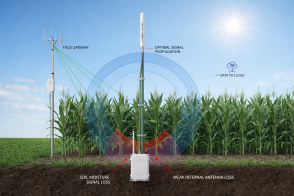
Soil moisture is the most serious threat to a soil sensor antenna. Water is a "dielectric" medium, which absorbs and reflects RF radiation.
To ensure your data reaches the cloud, follow these three golden installation rules:
If your sensor is buried, consider employing an external antenna connected by a ruggedized wire that extends 1-2 meters above ground. Even a slight height adjustment might double your transmission range.
Keep antennas away from metal fence posts, heavy machinery tracks, and dense "bottom-land" areas with standing water.
Most IoT antennas are omnidirectional. For optimal results, position them vertically. If the antenna is slanted, the "donut-shaped" signal pattern will face the ground or sky rather than your gateway.
As we approach 2026, the emphasis has switched from "more data" to "smarter data."
Selecting the right antenna for your agricultural soil sensors is the difference between a high-functioning "Smart Farm" and a field full of expensive, silent plastic. Prioritize LPWAN compatibility, account for soil attenuation, and always protect your hardware from the elements.






Comments : 0